Are
you thinking about installing a grand piano in your living room in Longueuil, placing a bookcase packed to the brim in your office, or moving a full-size refrigerator without damaging your beautiful hardwood floor? These are legitimate concerns that our clients regularly bring up at the L’Artisan Espace Design showroom in Brossard. The question of how much weight a hardwood floor can withstand comes up often, and the answers found online are all too often vague or imprecise.
The good news: a hardwood floor that’s properly installed on a solid subfloor is remarkably durable. The not-so-good news: in the vast majority of cases, it’s not the floor itself that’s the limiting factor, but rather the subfloor structure beneath it. Here’s everything you need to know to make the right choices for your home on the South Shore.
This guide is intended for both homeowners who want to better understand the limitations of their current floor and those planning a renovation who want to ensure their new hardwood floor will meet their needs.
Understanding Floor Strength: Two Distinct
Realities
When discussing the weight a floor can support, it’s important to distinguish between two very different realities. On one hand, there is the strength of the hardwood itself as a surface material—that is, its ability to resist denting, cracking, or becoming damaged under localized pressure. On the other hand, there is the load-bearing capacity of the floor structure—that is, the joists, subfloor, and everything else that supports the surface covering.
In the vast majority of common residential situations, it is the structure that determines the actual limit. A 3/4-inch-thick hardwood floor installed over a solid subfloor can theoretically support considerable loads, but if the joists are undersized or the span is too long, the structure will give way first, long before the wood warps.
It’s also important to understand the difference between a uniformly distributed load and a point load. A 300 kg piano, whose weight is distributed across four wide legs, exerts a very different pressure than a heavy dresser resting on four small, hard wheels. It is the pressure per unit area (kPa or kg/cm²) that matters, not just the total weight.
Under Quebec building codes, residential floors are designed to support a uniform live load of approximately 1.9 kPa (40 lb/ft²) to 2.4 kPa (approximately 40 to 50 pounds per square foot). This represents the normal weight of occupants, furniture, and personal belongings distributed across the entire surface area of a room.
What is the surface hardness of hardwood?
Hardwood, as a surface material, is rated on the Janka scale, which measures the hardness of a wood species based on the force required to drive a steel ball into the wood. The higher the Janka rating, the more resistant the wood is to indentations and scratches.
- Hard maple (Acer saccharum): 1,450 lbf — one of the hardest floorboards available in Quebec.
- White oak: 1,360 lbf — an excellent balance between hardness and stability.
- Red oak: 1,290 lbf — very popular for residential flooring.
- American walnut: 1,010 lbf — softer, but highly prized for its aesthetic appeal.
- White pine: 380 lbf — very soft; not recommended for high-traffic areas.
For hardwood floors commonly found on the South Shore, species such as maple, oak, and ash offer entirely satisfactory resistance to indentation for normal residential use. The risk of permanent indentation under heavy furniture remains low if appropriate protective glides are used.
The real limits: when should you be concerned?
Certain objects warrant special attention because their weight is concentrated over a small area. Grand pianos are the classic example: a concert grand can weigh between 200 and 480 kg. The load is concentrated on three to six feet, which can result in a pressure of 40 to 80 kg per foot, depending on the model. For standard residential homes in Brossard or Longueuil built after the 1980s, this rarely exceeds the structural limits of a properly dimensioned floor.
Aquariums pose an often-underestimated risk: a 500-liter aquarium weighs about 550 kg (including water and equipment), which is a considerable load if the floor structure wasn’t designed to support it. Heavy safes (over 200 kg) can also pose a problem if placed in the center of a large joist span.
A wall-mounted bookshelf filled with books can easily weigh 300 to 400 kg. If it is placed along a load-bearing wall, the problem is generally less severe. If it is in the center of a room with a wide span, the situation must be assessed. In homes in Saint-Lambert or La Prairie built between the 1950s and 1970s, an assessment by a structural engineer is recommended before installing very heavy loads.
What is less often discussed is the impact of dynamic loads on hardwood floors. The pressure from a stiletto heel can reach 150 kg/cm², which is several times the pressure that the same weight would exert if distributed across the entire sole of a flat shoe. This is one of the reasons why soft hardwood floors are easily marked, despite having perfectly adequate structural strength.
How can you protect your hardwood floor from heavy loads?
Use
- high-quality felt pads under all furniture legs: thick felt pads distribute the load more evenly and prevent scratches. Replace them regularly.
- Rugs or mats under high-traffic areas: A well-chosen rug under a heavy sofa or dining table spreads the weight over a larger surface area.
- Load-distribution platforms for highly concentrated loads: for a grand piano or an aquarium, a platform made of thick plywood (3/4 inch) spreads the weight over a much larger area.
- Avoid hard casters on hardwood floors: opt for wide, soft rubber casters or glides.
- Controlled humidity: maintain a relative humidity level between 35% and 55% in your home to prevent seasonal warping.
Engineered hardwood vs. solid hardwood: what’s the difference in terms of strength?
Engineered hardwood consists of cross-laminated layers of wood with a natural wood veneer on the surface. Its laminated structure provides excellent dimensional stability in the face of humidity fluctuations, which is a real advantage in Quebec’s climate. In terms of load-bearing capacity, engineered wood performs comparably to solid wood under normal loads.
The main difference lies in the ability to sand and refinish: a 3/4-inch solid wood floor can be sanded and refinished several times over its lifetime, whereas engineered wood has a thinner top layer that limits the number of refinishes possible.
FAQ — Weight and Strength of Hardwood Flooring on the South
Shore
How much weight can a hardwood floor support per square foot?
The Quebec standard for residential floors is approximately 40 to 50 pounds per square foot (1.9 to 2.4 kPa) under uniform load. For heavier, concentrated loads (piano, safe, aquarium), it is recommended that you consult a professional to assess the floor structure specific to your home.
Can my hardwood floor support a grand piano?
In most residential homes on the South Shore built to Quebec building code standards, a standard-sized grand piano (300 to 400 kg) can be placed without any issues, provided it is positioned perpendicular to the joists and preferably near a load-bearing wall. For very heavy concert grand pianos (over 450 kg), consultation with a structural engineer is recommended.
Do high heels damage hardwood floors?
Yes, stiletto heels can leave marks on softer woods such as pine or walnut. Very hard woods like maple are more resistant, but no wood is completely immune. Heel protectors (rubber caps) or a rug in high-risk areas are the best precautions.
Can hardwood flooring be installed over a subfloor in poor condition?
No, and this is a critical point. The subfloor must be dry, level (less than 3/16 in. over 10 ft.), and structurally sound before installation. A defective subfloor can cause creaking, warping, gaps between planks, and ultimately a shorter lifespan for the floor.
Can an aquarium be set up on a hardwood floor in the basement?
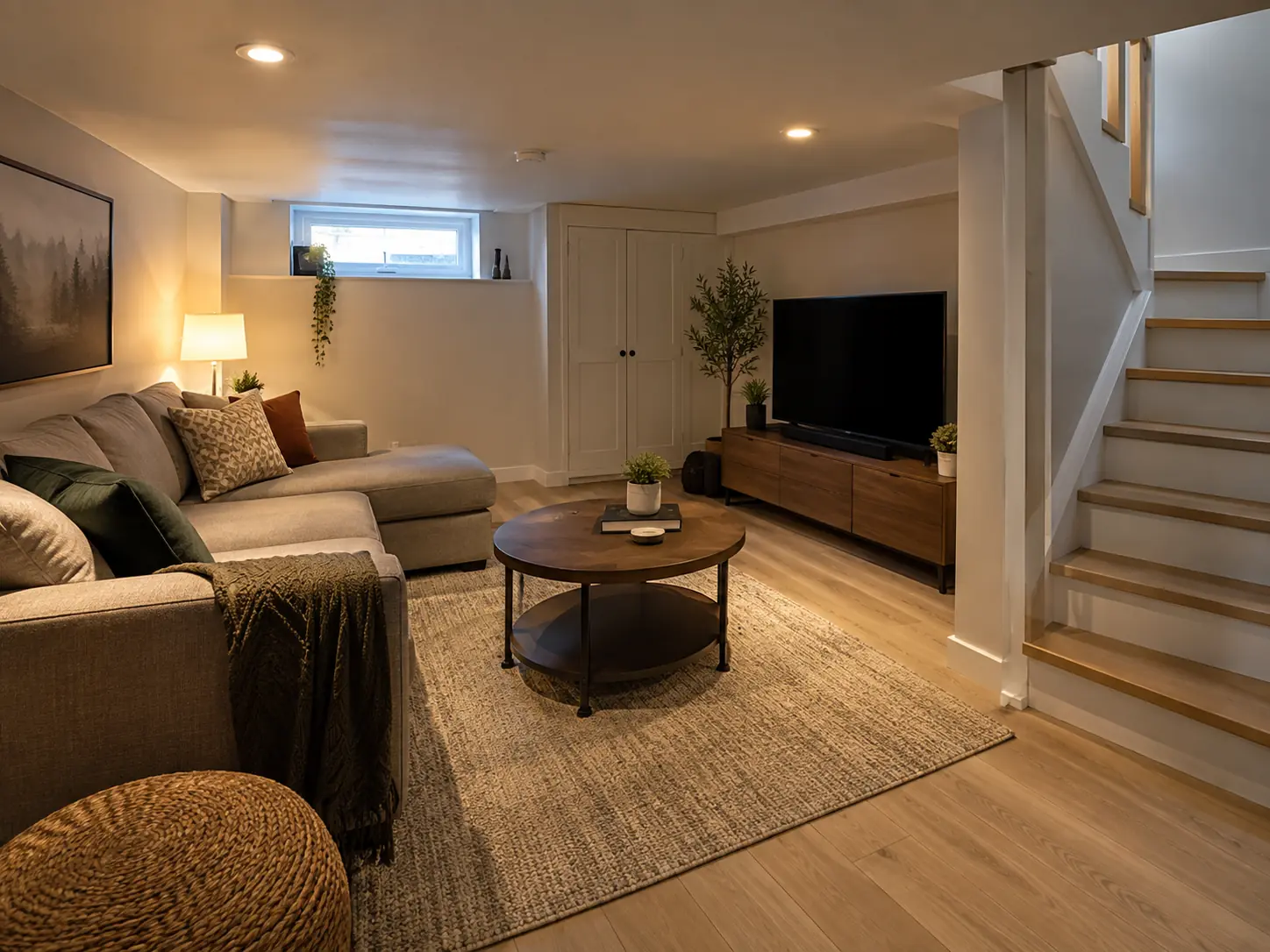
The basement rarely poses a structural problem for aquariums, since the concrete slab is directly on the ground. The main issue in the basement is rather the moisture generated by the aquarium, which can damage the hardwood floor if spills occur. We recommend placing an aquarium on a waterproof vinyl floor in the basement rather than on hardwood.
How can I tell if my floor is under excessive stress?
Signs of a floor under excessive stress include persistent and new creaking sounds, visible sagging in high-traffic areas, gaps opening up between the planks, or a “spongy” feeling underfoot in certain spots. If you notice these symptoms, contact a professional for an evaluation.
Does installing
a floor
over radiant heating affect the durability of hardwood?
Radiant heating increases dimensional changes in hardwood. To optimize durability and stability, it is recommended to use narrower planks (less than 3 inches), engineered wood rather than solid wood, and to maintain a surface temperature below 27°C. Wood species with a low coefficient of expansion, such as oak or ash, are preferable.
Can a well-maintained hardwood floor last 100 years?
Absolutely. Solid hardwood floors in century-old homes in Saint-Lambert and Longueuil are living proof of this. A 3/4-inch hardwood floor can be sanded and refinished 5 to 7 times over its lifetime, extending its life practically indefinitely with proper care.
Can you install a hardwood floor in a basement where there’s a risk of moisture?
It’s not recommended. Solid hardwood is very sensitive to moisture and can swell, warp, or develop mold in a damp basement. For basements, we recommend SPC vinyl flooring (waterproof) or engineered wood with a good vapor barrier, if conditions allow.
Do you have a project on the South Shore? Request a free quote from the team at L’Artisan Espace Design.