At L’Artisan Espace Design, we’re often asked what kind of flooring to install in a basement on the South Shore. A basement doesn’t behave like other rooms in the house: sitting directly on a concrete slab and exposed to ambient moisture, it faces challenges that the rest of the home doesn’t. The wrong flooring choice can warp, develop mold, or wear out in just a few years. Here’s our guide to finding the best flooring for a basement on the South Shore, featuring the four options that truly stand the test of time and how to choose between them.
A Basement Operates by Its Own Rules
Unlike a ground floor built on a wood-frame structure, a basement rests on a concrete slab in direct contact with the ground. This slab absorbs moisture from the surrounding environment and gradually releases it, sometimes without any visible signs of moisture penetration. The freeze-thaw cycles characteristic of Quebec’s climate exacerbate this phenomenon and cause the basement temperature to fluctuate from season to season. A flooring material suitable for the main floor is therefore not automatically suitable for installation below ground level.
After several years of installing floors on the South Shore, this is the mistake we see most often: a flooring material that looks beautiful in the showroom but proves ill-suited once installed below ground level.
Three Criteria for Choosing the Right Basement
Flooring
Before comparing the different options, it’s best to understand what’s required of them. Here are the three factors that consistently come up in our on-site assessments.
Resisting moisture and water vapor
Even a slab that appears dry can continuously release water vapor. A basement flooring must therefore account for this reality. Depending on the product and installation method, a vapor barrier or a moisture protection system may be necessary. This protection must meet the manufacturer’s requirements: it does not replace the repair of a leak.
Providing Comfort Underfoot
Concrete naturally retains coolness, and this sensation is transmitted through a flooring system installed without insulation. In winter, a poorly insulated basement can become uncomfortable to walk on barefoot. An insulated subfloor or a naturally warmer material completely transforms the day-to-day experience.
Withstanding Heavy Use
Whether it’s
a family room, home office, or play area, the basement often serves multiple purposes at once. The flooring you choose must therefore withstand heavy foot traffic without deteriorating prematurely. Good dimensional stability makes all the difference over the years.
The Best Flooring for a Basement on the South
Shore
At L’Artisan Espace Design, four options are worth comparing for a basement: luxury vinyl, ceramic tile, epoxy concrete, and engineered wood. Each meets different needs, and the right choice depends primarily on the intended use, humidity conditions, and the desired level of comfort.
Luxury vinyl (LVP): a safe
bet
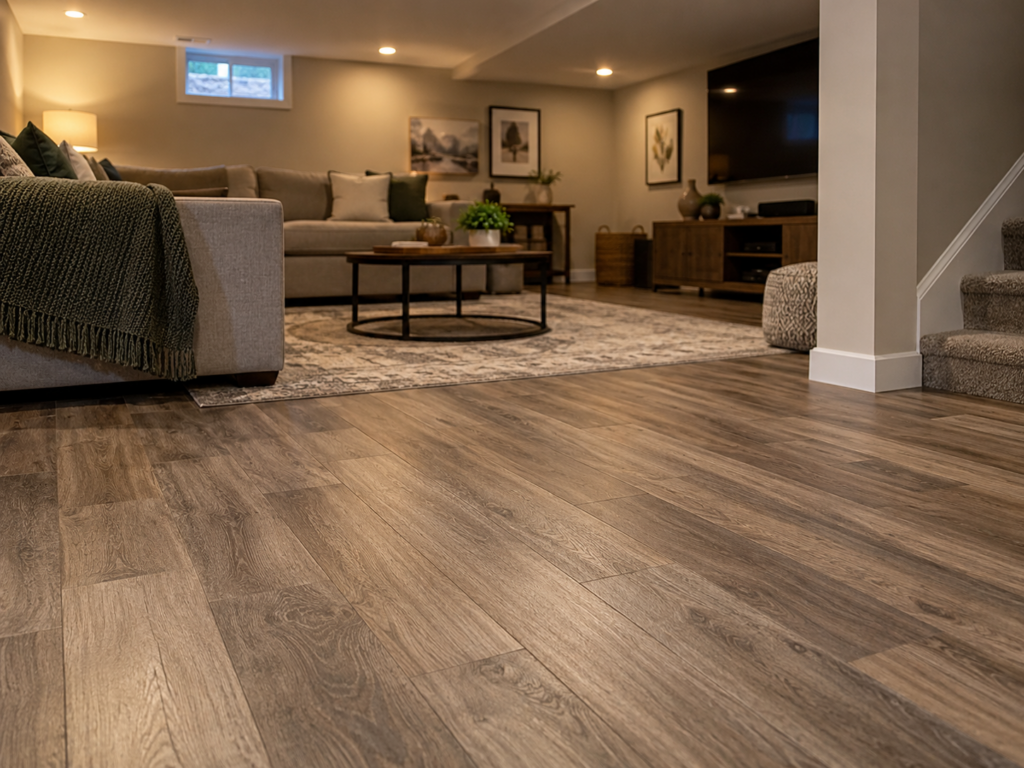
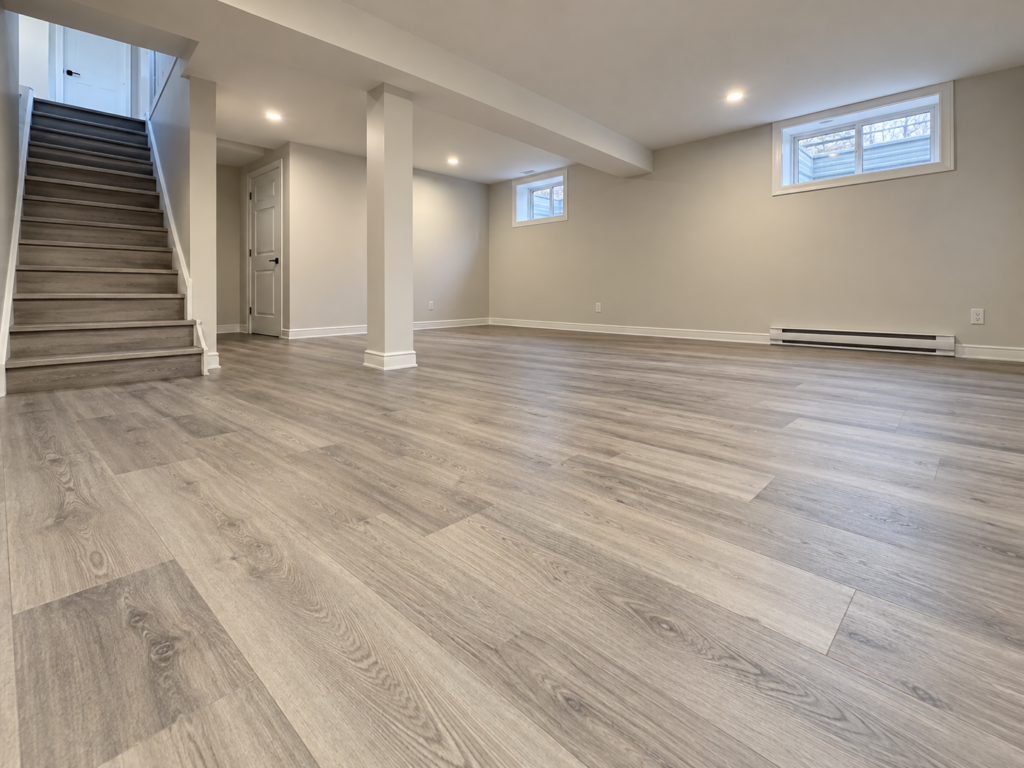
Luxury vinyl is our most common recommendation for a basement. SPC-type rigid-core vinyl is often a good option for a floating installation, provided you choose a suitable product and follow the subfloor preparation requirements.
- Resistant to water and daily wear and tear, depending on the line chosen, without preventing moisture from accumulating beneath the flooring,
- More comfortable underfoot than ceramic tile or epoxy, although an uninsulated tile can remain cold;
- cost varies depending on the product, installation, and necessary preparation work (4$ to 14$ per square foot),
- Allow the flooring to acclimate according to the manufacturer’s instructions, taking into account transportation and storage conditions (24 to 48 hours before installation, especially in winter on the South Shore).
Thickness, wear layer, plank sizes: all the criteria for making the right choice are detailed in our SPC vinyl flooring buying guide.
Epoxy concrete: a durable, seamless
alternative
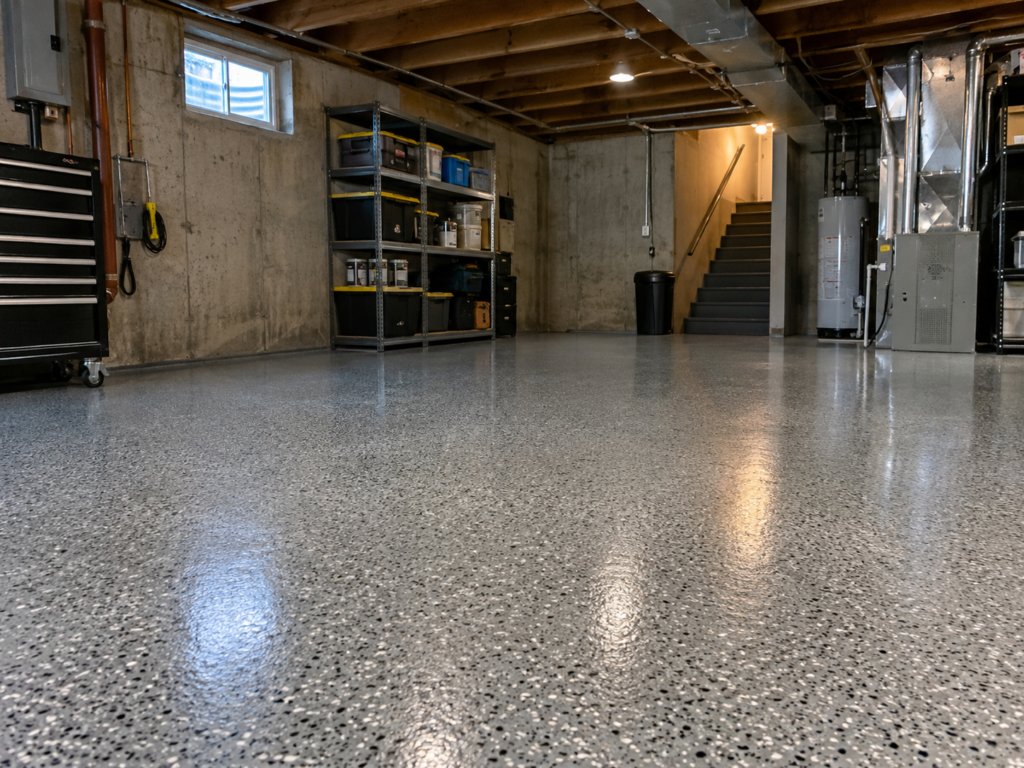
For a basement used as a garage, utility room, or high-traffic area, epoxy concrete (or polyaspartic) is an option worth serious consideration. Applied directly to the existing slab, it creates a seamless surface.
- Moisture- and chemical-resistant;
- minimal maintenance—just occasional sweeping and damp mopping;
- ideal for garages, utility spaces, or high-traffic areas;
- pricing varies depending on the floor area, the condition of the concrete slab, and the system chosen (flake, solid color, or polyaspartic). For an exact price, request a free estimate.
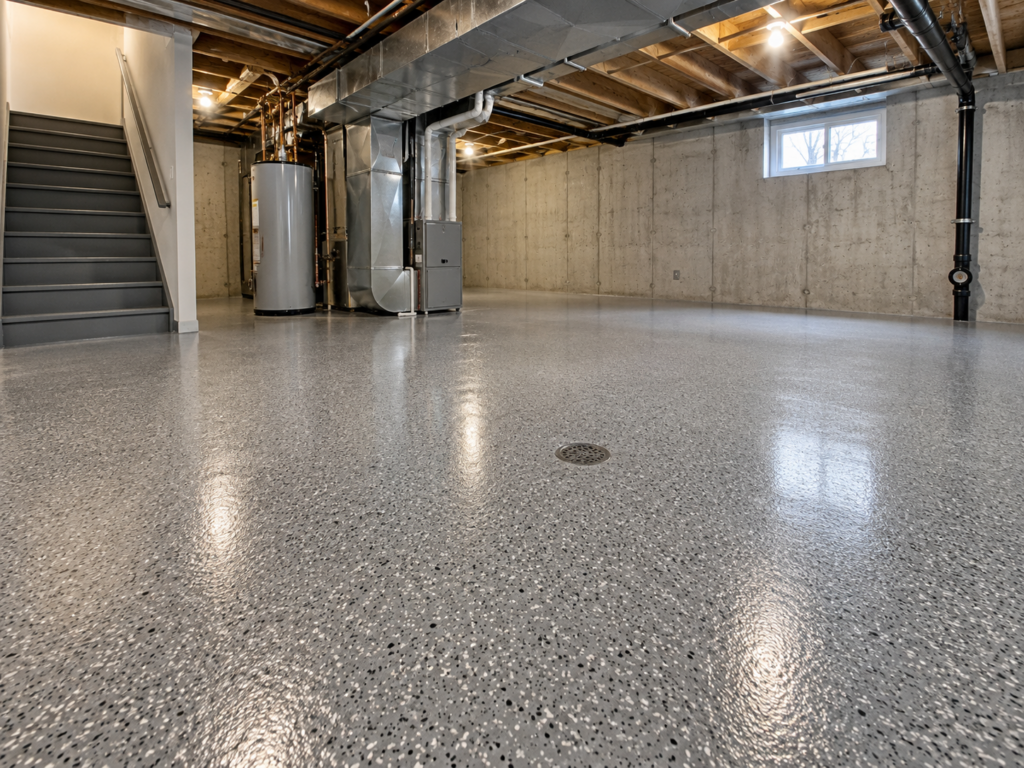
Our page dedicated to epoxy concrete showcases our various systems and their applications.
Note: The durability of the finish does not eliminate the need to check the concrete’s moisture content. A slab that is too damp can compromise the coating’s adhesion, and expansion joints must be preserved or treated according to the system’s requirements.
Ceramic Tile: A Durable
Option
Ceramic tile is another option to consider for a basement, especially in a bathroom, laundry room, or space with radiant floor heating. For these rooms, porcelain stands out for its low water absorption and durability.
- Water-resistant and easy to clean;
- durable, even in high-traffic areas;
- compatible with radiant floor heating to counteract the coolness of concrete;
- remains cool and firm underfoot without heating—a factor to consider for a family room.
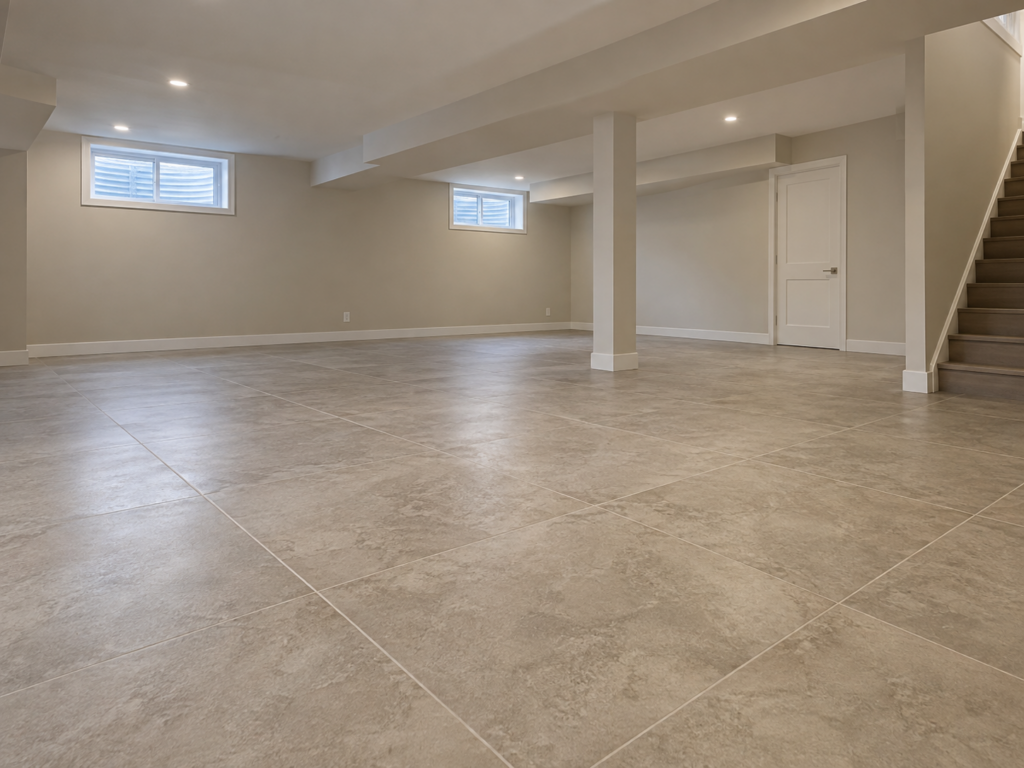
Before installation, the subfloor must be properly prepared: cracks and irregularities can compromise the stability of the tiles and grout. As with other flooring materials, ceramic tile does not solve water infiltration problems.
Our page dedicated to tile and ceramic flooring presents the various options available for your project.
Engineered wood:
proceed
with caution
Engineered wood can also be used in a basement, provided you proceed with caution.
- It features a plywood core that limits the wood’s natural movement and is more stable than solid hardwood;
- however, it remains susceptible to standing water, unlike vinyl or epoxy.
- It is recommended only after verifying the slab’s moisture content.
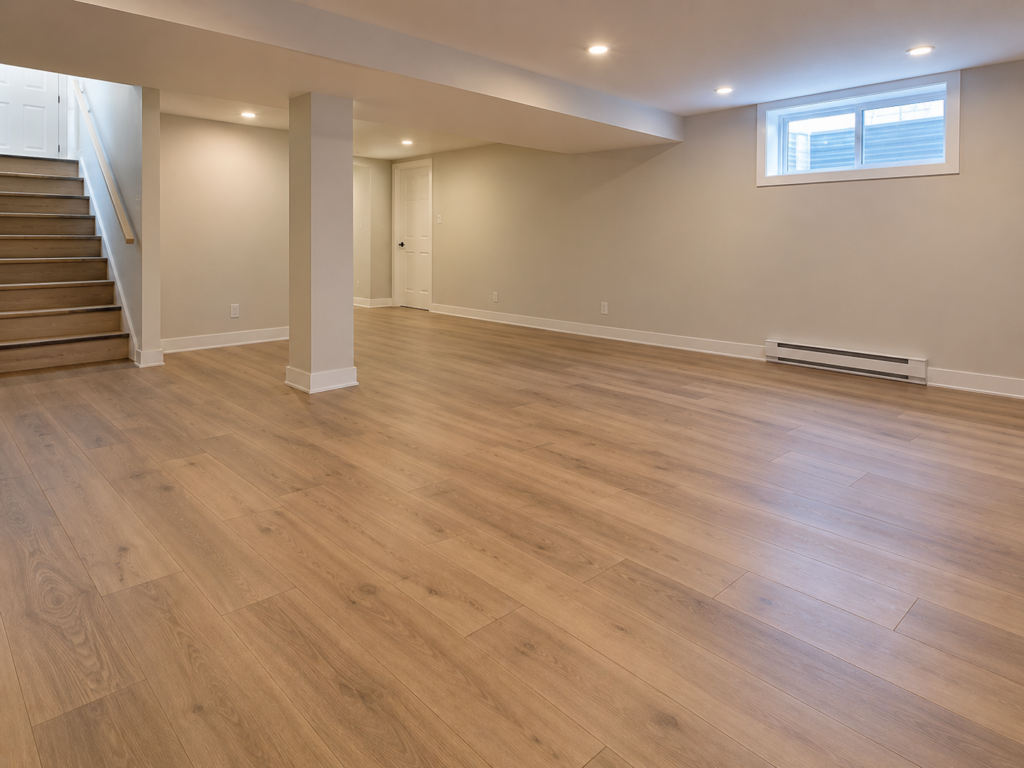
Before recommending it for a basement, we systematically check the slab’s moisture content: without this verification, the risk of warping remains real.
Good to know: there’s no need to choose a single option for the entire basement. An utility room is well-suited for epoxy concrete, a bathroom for ceramic tile, while a family room can benefit from the comfort of vinyl. This zone-by-zone approach often helps optimize both budget and performance.
Comparison of the Best Basement
Flooring Options
Here’s a comparison of the four options to help you weigh their pros and cons based on how you’ll use your basement.
| Flo | oring | Material | Best Suited For | | Underfoot Comfort | | Water Resistance | | | Key Consideration | | ||
|---|---|---|---|---|---|---|---|---|
| Luxury Vinyl (LVP/SPC) | | Family room, office, or bedroom | | More comfortable than ceramic tile or epoxy, but does not replace insulationThe | material is water-resistant, but moisture can become trapped underneathEnsure | the subfloor is level and follow the | ||||
| manufacturer’s | ||||||||
| moisture protection requirementsCeramic | ||||||||
| and | porcelainBathroom, laundry room | , | or rooms with heated floorsHard | , cold | surface | without | heatingVery good water resistance, especially for porcelainTile | cracks and the necessary waterproofing in exposed areas |
| E | ||||||||
| po | ||||||||
| xy concreteWorkshop | , mechanical room, or utility space. | Hard, | cool | surface | . Resistant to surface liquids, but requires a tile compatible with the chosen system | . Concrete preparation and moisture from the | ||
| substrate. Engineered wood | . | Living room | , office, or bedroom in a | dry | basementWarm | and inviting in a living spaceSensitive | to standing water and excessive moistureA product | approved for basements and controlled |
| humidity conditions |
Key takeaway: No single flooring material can solve a water infiltration problem on its own. Before choosing a finish, make sure the basement conditions allow for a durable installation.
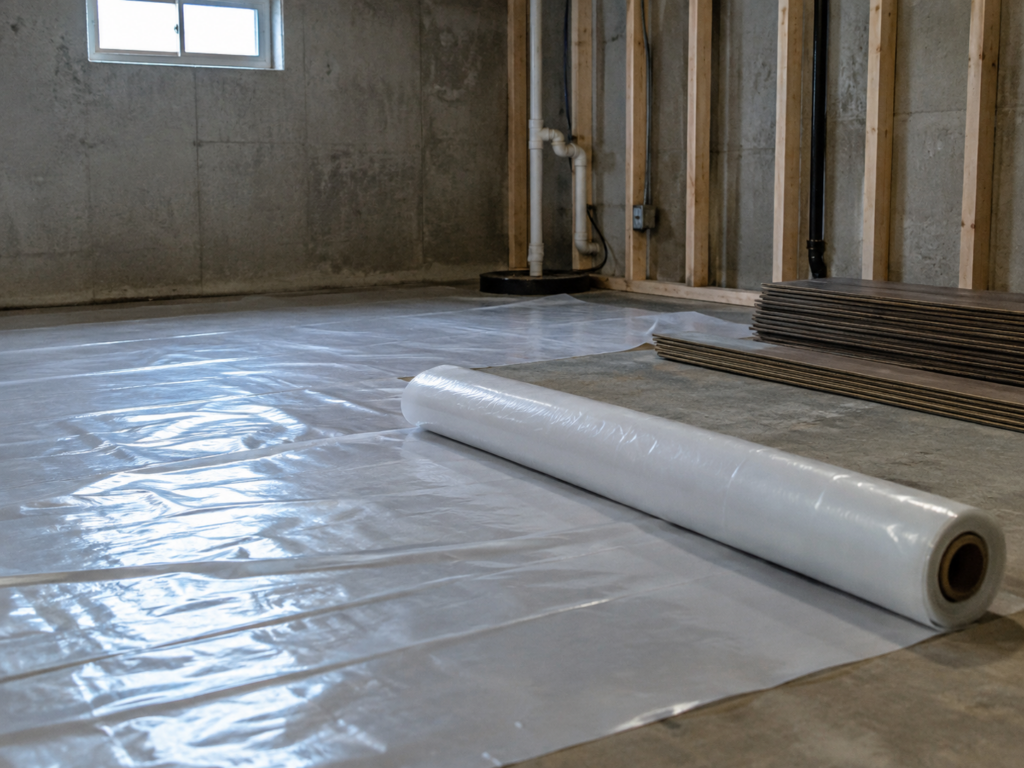
Subfloor preparation: the key step for a durable
basement floor
. No matter which flooring you choose, a poorly prepared subfloor will compromise the entire project. Before installation, a few checks are essential:
- The subfloor must be clean, solid, and sufficiently level, according to the tolerances of the chosen flooring.
- Cracks must be assessed and repaired before installation, taking into account potential movement of the concrete.
- An appropriate moisture test verifies whether the slab meets the system’s requirements. A vapor barrier may still be required even if the test results are acceptable.
- A new slab must have reached the required curing and drying conditions. The time elapsed since pouring does not replace pre-installation checks.
- Epoxy concrete requires appropriate mechanical preparation, such as grinding or shot blasting, as well as a review of application conditions.
- For ceramic tile, preparation may include a decoupling or waterproofing membrane, depending on the substrate and the room’s intended use.
Skipping any of these steps means running the risk of having to redo the entire project a few months later, regardless of the quality of the chosen flooring.
L’Artisan Espace Design, by your side on the South
Shore
Choosing the best basement floor always depends on the actual conditions of your home, and these conditions vary from one house to another. Whether you’re in Longueuil, Brossard, Saint-Hubert, or elsewhere on the South Shore, our team assesses the moisture levels, the concrete slab, and the intended use before recommending a flooring solution tailored to your basement. Visit our showroom at 8255A Taschereau Boulevard in Brossard, or contact our team for a personalized assessment and a free estimate.
FAQ
: Vinyl, ceramic, epoxy, or engineered wood—which should I choose for my basement?
It depends mainly on the room’s intended use and conditions. For a living room or bedroom, vinyl offers a good balance between comfort and ease of maintenance. Ceramic tile works well in a bathroom or laundry room, especially with radiant floor heating. Epoxy concrete is a practical option for utility areas. Engineered wood may be suitable for a dry living space, provided the product is approved for basement use.
Is a vapor barrier always necessary?
Not in the same form for all flooring types. On a concrete slab, some manufacturers require a vapor barrier under a floating floor, even when the moisture test results are acceptable. A glued-down installation or an epoxy coating may require a different protective system. The choice therefore depends on the product, the installation method, and the condition of the concrete slab.
Can solid hardwood or carpet be installed in a basement?
No, neither one. Solid hardwood is too sensitive to moisture for a basement, regardless of the quality of the installation. Wall-to-wall carpet poses a similar problem: it traps moisture rather than repelling it, which can compromise indoor air quality in a finished basement.
Is epoxy concrete suitable for a finished basement with living spaces?
Yes, especially in a decorative flake finish or solid color, but it’s less comfortable underfoot than vinyl. It’s a more common choice for utility areas than for a family room.
How long does a well-chosen basement floor last?
High-quality SPC vinyl, when properly installed, generally lasts 20 to 30 years, with possible lifetime warranties for products with a wear layer of 20 mils or more. Epoxy concrete, on the other hand, is virtually non-warping and lasts as long as the slab itself, requiring only a simple surface refresh as needed.