Home / Blog / How to Clean a Hardwood Floor Without Damaging It
A well-maintained hardwood floor can last for generations. If cleaned improperly, it quickly loses its luster: the finish becomes dull, scratches become more noticeable, and dirt becomes embedded in the grain. However, cleaning a hardwood floor isn’t complicated at all—as long as you know the right techniques and products. Should you dust before washing a […]
In this article
A well-maintained hardwood floor can last for generations. If cleaned improperly, it quickly loses its luster: the finish becomes dull, scratches become more noticeable, and dirt becomes embedded in the grain. However, cleaning a hardwood floor isn’t complicated at all—as long as you know the right techniques and products.
Should you dust before washing a hardwood floor?
Yes, and you should do it every time. Sand and dust act as abrasives: letting them slide under a damp mop is like rubbing sandpaper against the floor’s finish.
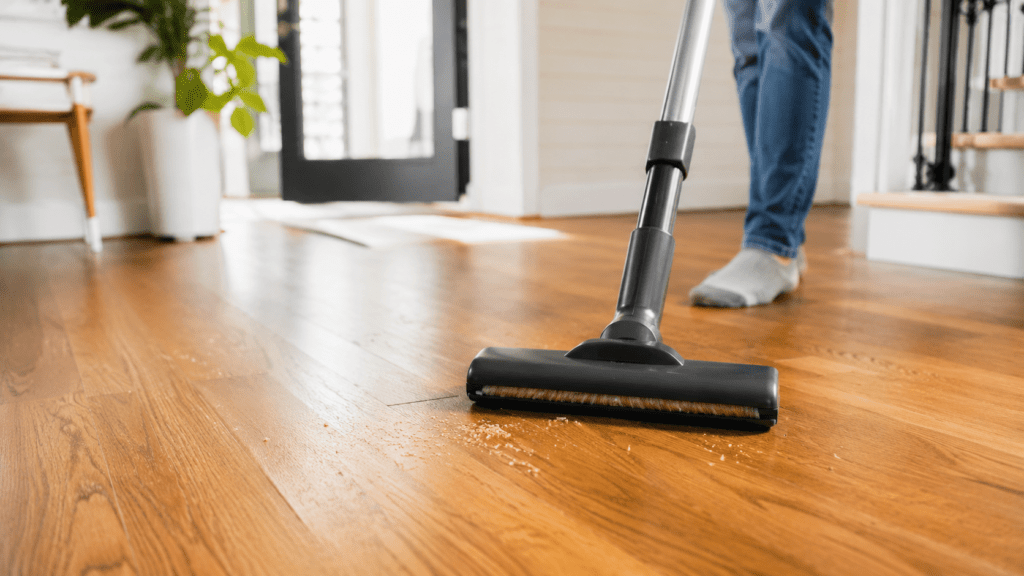
A soft-bristled broom, a vacuum cleaner equipped with a hardwood floor brush attachment, or a microfiber cloth is all you need to remove these particles before mopping. This step, which is often overlooked, accounts for much of the premature wear seen on floors that are otherwise cleaned regularly.
What product should you use to clean a hardwood floor?
To properly clean a hardwood floor, the best option is a pH-neutral cleaner specifically designed for this type of surface, as it cleans without damaging the finish.
If that’s not available, a mild, water-based soapy solution can be used for routine maintenance, in controlled amounts. Avoid standard household detergents, solvents, and any abrasive products: they can dissolve or dull the finish over time.
What about vinegar? It’s not a recommended option. On a varnished or oiled floor—regardless of the type of finish—the acidity of vinegar acts as a harsh agent when it comes into contact with the wood and can cause the finish to dull unevenly with repeated use. It’s better to stick to a water-based solution or a cleaner designed for wood rather than risk damaging the finish.
How do you properly clean a hardwood floor?
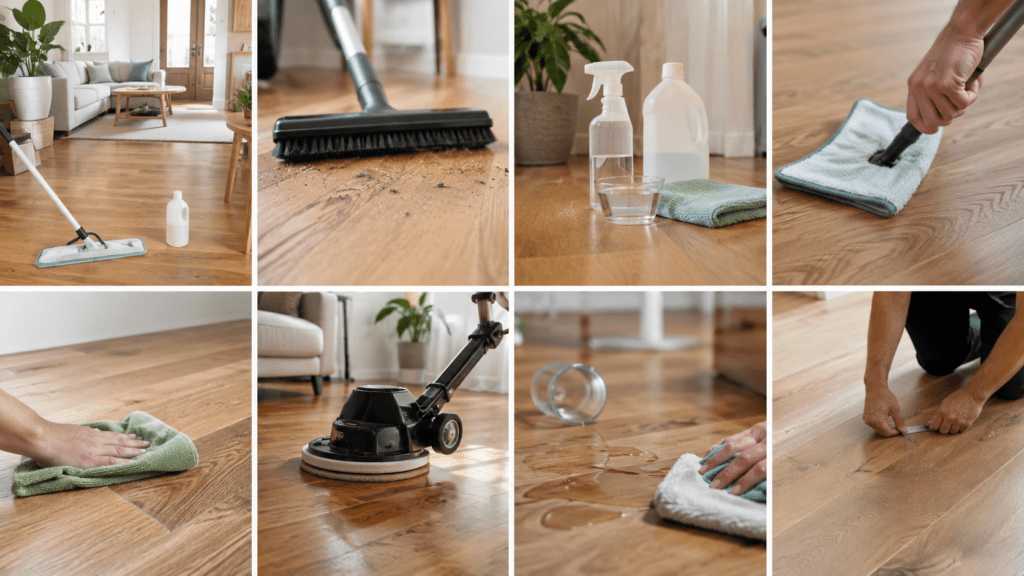
Hardwood and large amounts of water don’t mix well. A microfiber mop that’s barely damp—never soaking wet—is the go-to tool.
A few simple tips make all the difference:
Apply the cleaner to the mop before mopping, rather than pouring the product directly onto the floor; this helps keep moisture better controlled.
Move the mop along the grain of the planks rather than across it; this minimizes streaks on the finish.
Finish by quickly drying the floor with a dry cloth: water left on the surface for too long is what eventually seeps between the planks.
Why be so careful with water? Hardwood is a living material that absorbs moisture from the air. Excessive water—or water left to dry naturally—can seep between the planks, causing localized swelling and, over time, delamination or warping of the finish.
Deep Cleaning: How Often?
Routine maintenance isn’t enough to remove stubborn stains or residue that builds up over time. A more thorough cleaning—about every two weeks, depending on the room’s traffic—keeps the floor truly clean deep down.
However, the exact frequency and the best product to use depend on the type of finish: always follow the manufacturer’s recommendations, then let the floor dry completely before moving the furniture back into place.
Mistakes That Damage a Hardwood
Floor
Certain habits prevent you from properly cleaning a hardwood floor and cause it to wear out much faster than you might think:
Excess water—even if only occasional—that has time to seep between the planks.
A product unsuitable for the type of finish, such as detergent, solvent, or vinegar.
Dust and sand allowed to accumulate between cleanings.
Uncertainty about the type of finish, which is ignored rather than verified before applying a product.
These mistakes almost always result in the same outcome: an unevenly dulled finish, visible scratches, and a shortened floor life.
Protecting the Luster of Hardwood Floors Over the Long Term
A floor that stays beautiful for years is no accident. Depending on the type of finish, a polishing product applied from time to time can restore the surface’s luster without requiring sanding. For oiled finishes, a suitable oil treatment deeply nourishes the wood—an option that, however, does not apply to all types of finishes.
Good to know: A floor cleaned at least once a week is easier to maintain over the long term and delays the need for sanding.
When is cleaning no longer enough?
Cleaning maintains an existing finish; it cannot restore a finish that is already worn, dulled, or marked by deep scratches. A scratched finish, a color that fades despite proper maintenance, or an unusual reaction after cleaning are generally signs that simple maintenance is no longer enough.
At this stage, it’s time to move from routine maintenance to a professional assessment, which will determine whether polishing is sufficient or if a complete sanding is necessary to give the wood a new lease on life.
Does your floor have dull spots, an unusual reaction after cleaning, or deep scratches? An assessment will determine whether enhanced maintenance is sufficient or if restoration is preferable. Our South Shore advisors will be happy to assist you.
Key Takeaways
:
Dust before washing—this is the step most often overlooked.
Opt for a pH-neutral cleaner or a water-based solution; avoid vinegar, regardless of the type of finish.
Use a slightly damp microfiber mop and dry with a cloth.
A deep clean every two weeks rounds out your routine maintenance.
A dull or marked finish, even with proper maintenance, is a sign that it’s time to seek professional advice.
At L’Artisan Espace Design, our team handles the sale, installation, and sanding of hardwood floors, with consultants who can assess the condition of your floor and guide you toward the right solution. Stop by our showroom in Brossard—no appointment needed—or request a free quote.
Pour offrir les meilleures expériences, nous utilisons des technologies telles que les témoins pour stocker et/ou accéder aux informations des appareils. Le fait de consentir à ces technologies nous permettra de traiter des données telles que le comportement de navigation ou les ID uniques sur ce site. Le fait de ne pas consentir ou de retirer son consentement peut avoir un effet négatif sur certaines caractéristiques et fonctions.
Fonctionnel
Always active
Le stockage ou l’accès technique est strictement nécessaire dans la finalité d’intérêt légitime de permettre l’utilisation d’un service spécifique explicitement demandé par l’abonné ou l’utilisateur, ou dans le seul but d’effectuer la transmission d’une communication sur un réseau de communications électroniques.
Préférences
Le stockage ou l’accès technique est nécessaire dans la finalité d’intérêt légitime de stocker des préférences qui ne sont pas demandées par l’abonné ou l’utilisateur.
Statistiques
Le stockage ou l’accès technique qui est utilisé exclusivement à des fins statistiques.Le stockage ou l’accès technique qui est utilisé exclusivement dans des finalités statistiques anonymes. En l’absence d’une assignation à comparaître, d’une conformité volontaire de la part de votre fournisseur d’accès à internet ou d’enregistrements supplémentaires provenant d’une tierce partie, les informations stockées ou extraites à cette seule fin ne peuvent généralement pas être utilisées pour vous identifier.
Marketing
Le stockage ou l’accès technique est nécessaire pour créer des profils d’utilisateurs afin d’envoyer des publicités, ou pour suivre l’utilisateur sur un site web ou sur plusieurs sites web ayant des finalités marketing similaires.