Le savon noir, c’est le grand retour en force dans les maisons de la Rive-Sud. On l’utilise pour nettoyer les surfaces en béton, les carrelages, les salles de bain… et de plus en plus souvent, les planchers en bois. Sur Instagram et Pinterest, les influenceurs déco en vantent les mérites pour entretenir un parquet huilé ou ciré. Mais est-ce vraiment adapté à tous les types de plancher en bois ?
La réponse courte : le savon noir peut être excellent pour certains planchers et complètement contre-indiqué pour d’autres. La différence tient à un seul facteur : le type de finition de votre plancher. Dans cet article, l’équipe d’L’Artisan Espace Design vous explique tout — quand le savon noir convient, comment l’utiliser correctement, et surtout quand l’éviter absolument.
Qu’est-ce que le savon noir ?
Le savon noir (ou savon de Marseille liquide) est un savon végétal à base d’huile de lin ou de chanvre, traditionnellement utilisé dans les pays du Maghreb et en Europe du Nord pour l’entretien des surfaces. Il se présente sous forme de pâte ou de liquide brun foncé à l’odeur légèrement huileuse.
Sa composition alcaline lui confère des propriétés nettoyantes et légèrement dégraissantes. À dilué correctement, il est biodégradable, non toxique et doux pour la plupart des surfaces. C’est d’ailleurs pour ces raisons qu’il est redevenu populaire dans les foyers québécois soucieux de réduire leur utilisation de produits chimiques.
Attention : le savon noir vendu en quincaillerie ou en épicerie naturelle peut avoir des compositions variables. Certains contiennent des additifs (parfums, colorants) qui peuvent tacher certaines surfaces. Privilégiez toujours un savon noir pur, à ingrédients simples.
Le savon noir est-il bon pour un plancher en bois ?
Voici la vérité que les influenceurs ne vous disent pas : le savon noir n’est PAS universellement compatible avec les planchers en bois. Tout dépend du type de finition appliquée sur votre plancher.
Pour les planchers huilés : OUI, avec précautions
C’est là que le savon noir excelle. Les planchers finis à l’huile naturelle (Rubio Monocoat, Osmo, Bona, Treatex) ont une surface poreuse où l’huile a pénétré dans le bois plutôt que de former une couche plastifiante en surface. Ces planchers réagissent très bien au savon noir dilué, qui nettoie en douceur sans empiéter sur l’huile et laisse le bois propre et légèrement nourri.
Pour un plancher huilé, c’est même la méthode d’entretien recommandée par plusieurs fabricants d’huiles naturelles. Le savon noir légèrement alcalin aide à maintenir l’équilibre de la surface et prévient l’accumulation de saletés dans les pores du bois.
Pour les planchers cirés ou savonnés : OUI, recommandé
Les planchers finis à la cire ou au savon blanc (méthode Scandinave) s’entretiennent traditionnellement avec… du savon ! Le savon noir dilué est parfait pour redonner de la vie à ces planchers et renforcer leur finition naturelle. C’est d’ailleurs la méthode d’entretien la plus courante pour les planchers en pin savonnés des vieilles maisons de la Rive-Sud.
Pour les planchers vernis ou laqués : NON, absolument pas
C’est ici que le bât blesse. Les planchers finis avec un vernis polyuréthane, une laque ou un vernis époxy ont une couche plastifiante en surface qui protège le bois. Le savon noir, légèrement alcalin, peut attaquer cette couche de vernis avec le temps. Résultat : un vernis qui blanchit, ternit ou perd son adhérence, et un plancher qui nécessite un sablage prématuré.
Sur la Rive-Sud, la grande majorité des planchers de bois franc posés depuis les années 1990 sont finis avec du vernis polyuréthane. Si vous ne savez pas avec certitude quel type de finition votre plancher a reçu, faites le test : déposez une goutte d’eau sur le plancher. Si elle perle (comme sur une voiture cirée), c’est du vernis. Si elle est absorbée en quelques secondes, c’est probablement de l’huile ou de la cire.
Pour le bois d’ingénierie flottant : DÉPEND de la finition
Les planchers d’ingénierie modernes sont le plus souvent pré-finis avec un vernis polyuréthane — donc incompatibles avec le savon noir régulier. Par contre, certains fabricants proposent des gammes d’ingénierie finies à l’huile naturelle qui se prêtent bien à l’entretien au savon noir. Vérifiez toujours les recommandations du fabricant avant d’utiliser un nouveau produit d’entretien.
Comment utiliser le savon noir sur un plancher huilé : mode d’emploi
Si votre plancher est compatible avec le savon noir, voici la méthode que notre équipe recommande pour un entretien optimal :
Étape 1 : Bien diluer le savon
C’est l’étape la plus importante. Ne jamais utiliser le savon noir pur ou concentré sur un plancher — vous risquez de laisser des traces grasses et de rendre la surface glissante. La dilution recommandée : 2 à 3 cuillères à soupe de savon noir pour 5 litres (1.3 gal US) d’eau tiède. L’eau doit être légèrement savonneuse, pas mousseuse.
Étape 2 : Balayer ou aspirer d’abord
Avant de laver, passez un balai à frange électrostatique ou un aspirateur pour retirer les poussières et les débris. Laver sans avoir enlevé la poussière revient à faire une boue légère qui s’incruste dans les pores du bois.
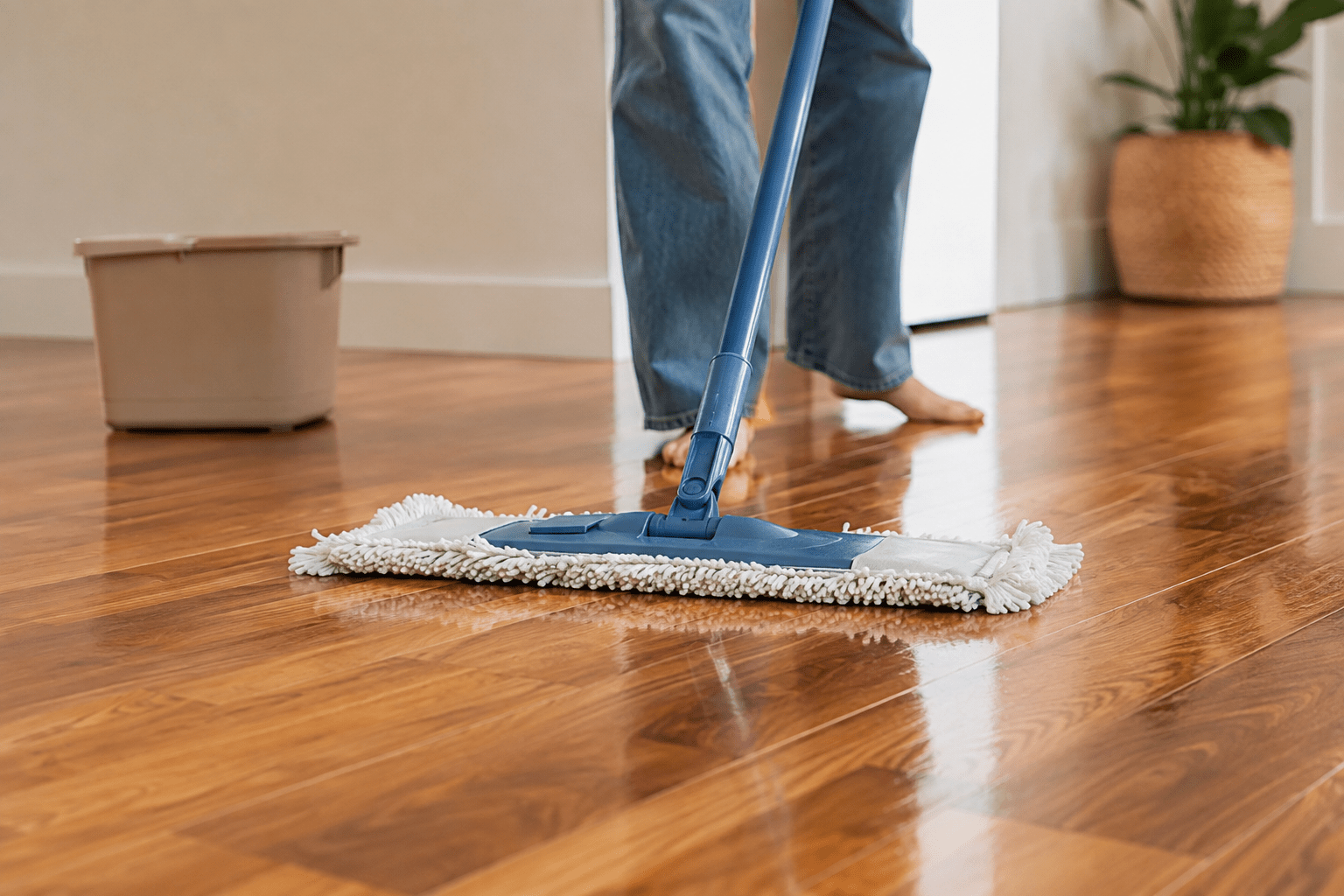
Étape 3 : Appliquer avec une vadrouille bien essorée
Utilisez une vadrouille en microfibre bien essorée — presque sèche. L’ennemi numéro un du plancher en bois, c’est l’excès d’eau. Lavez en suivant le sens du fil du bois (dans la longueur des planches) et rincez régulièrement votre vadrouille dans l’eau propre.
Sur la Rive-Sud, les maisons mal isolées peuvent avoir des variations d’humidité importantes entre l’été et l’hiver. Un excès d’eau sur un plancher de bois peut accélérer les variations dimensionnelles et créer des écarts entre les planches. La règle d’or : moins d’eau, c’est mieux.
Étape 4 : Ne pas rincer
Contrairement à la céramique, on ne rince pas un plancher de bois huilé après le lavage au savon noir. Le léger film résiduel de savon végétal est bénéfique — il renourrit légèrement le bois et améliore son aspect. Si vous voyez des traînées ou des taches claires après séchage, c’est que la dilution était trop forte ou la vadrouille trop humide.
Étape 5 : Laisser sécher naturellement
Évitez de marcher sur le plancher pendant le séchage (15-30 minutes selon la température ambiante). Pour accélérer le séchage, vous pouvez ouvrir les fenêtres ou augmenter légèrement la ventilation de la pièce. Évitez les courants d’air brusques qui pourraient faire gondoler le bois si la pièce n’est pas bien acclimatée.
Quelle fréquence d’entretien au savon noir ?
Pour un plancher huilé à fort trafic (salon, couloir, cuisine), le lavage au savon noir peut se faire une fois par semaine. Pour les chambres ou les espaces moins fréquentés, une fois par mois suffit largement. Entre les lavages, un simple balayage sec ou un passage à l’aspirateur suffit.
Sur la Rive-Sud, on constate souvent plus de saleté et de sable fin en hiver à cause du sel de voirie. En saison hivernale, vous pourriez donc nettoyer légèrement plus fréquemment près des entrées et des zones de passage.
Les alternatives au savon noir pour l’entretien des planchers vernis
Si votre plancher est verni et que vous cherchez un nettoyant naturel et efficace, voici les alternatives au savon noir :
- Nettoyant plancher pH neutre : des marques comme Bona, Pallmann ou Rubio proposent des nettoyants spécialement formulés pour les planchers vernis. Ils sont doux, sans danger pour le vernis et laissent peu de résidu.
- Eau légèrement vinaigrée : pour les entretiens légers, 1/4 tasse de vinaigre blanc dans 4 litres (1.1 gal US) d’eau. Attention : à éviter sur les finitions à l’huile car le vinaigre est acide et peut dégrader l’huile.
- Eau tiède seule avec vadrouille essorée : pour les nettoyages courants sans salissures particulières. Suffisant pour maintenir un plancher propre au quotidien.
- Nettoyant savon du fabricant : Rubio Monocoat propose son propre savon d’entretien (Surface Care Soap) adapté à ses planchers huilés. Ces produits sont formulés pour ne pas interférer avec la finition.
Les erreurs les plus fréquentes avec le savon noir sur les planchers
Dans nos interventions à Brossard et Longueuil, on voit souvent les mêmes erreurs répétées par les propriétaires qui ont essayé le savon noir sans trop savoir comment l’utiliser :
- Utiliser le savon noir pur, sans dilution : résultat garanti — plancher gras, traînées et surface glissante.
- Appliquer sur un plancher verni : peut blanchir le vernis et créer des taches opaques difficiles à enlever.
- Laisser sécher en flaques : si la vadrouille était trop humide, les flaques qui sèchent laissent des auréoles visibles.
- Utiliser de l’eau chaude : l’eau très chaude dilate le bois et peut faire gonfler les planches. Utilisez de l’eau tiède (max 40°C).
- Appliquer sans avoir dépoussiéré au préalable : la poussière mélangée à l’eau savonneuse forme une boue qui s’incruste dans les pores du bois.
Savon noir et planchers de la Rive-Sud : un mot sur l’humidité saisonnière
Au Québec, et particulièrement sur la Rive-Sud de Montréal, les variations d’humidité entre l’été (humide) et l’hiver (sec avec le chauffage) sont parmi les plus importantes en Amérique du Nord. Un plancher de bois franc peut varier de plusieurs millimètres en largeur selon les saisons.
Dans ce contexte, un nettoyage au savon noir trop fréquent ou trop humide peut accentuer les mouvements saisonniers du bois. Notre conseil : réduisez la fréquence des lavages humides en hiver (quand le chauffage assèche l’air) et optez pour un balayage sec ou à peine humide. En été, le lavage régulier au savon noir dilué est parfaitement approprié.
L’Artisan Espace Design : votre partenaire pour des planchers bien entretenus sur la Rive-Sud
Chez L’Artisan Espace Design, on connaît les planchers de la Rive-Sud comme si on les avait posés nous-mêmes — parce que dans bien des cas, c’est exactement ce qu’on a fait ! Notre équipe peut vous aider à identifier le type de finition de votre plancher et vous recommander le produit d’entretien le plus adapté.
Si votre plancher est usé, terne ou si la finition a été dégradée par de mauvais produits, un sablage et refinissage peut lui redonner une deuxième vie. Venez nous rencontrer dans notre salle montre à Brossard — on a des échantillons de toutes les finitions et on adore jaser plancher avec nos clients.
FAQ — Questions fréquentes sur le savon noir et les planchers en bois
Comment savoir si mon plancher est fini à l’huile ou au vernis ?
Le test de la goutte d’eau est le plus simple : déposez une petite goutte d’eau sur le plancher dans un coin discret. Si la goutte perle et reste en surface (comme sur du verre), c’est du vernis. Si elle est absorbée dans les 30 secondes, c’est probablement de l’huile ou de la cire. Vous pouvez aussi regarder sous un meuble non déplacé depuis longtemps — la zone protégée révèle souvent la couleur d’origine de la finition.
Le savon noir peut-il tacher un plancher clair en érable ?
Si bien dilué et bien appliqué, non. Par contre, un savon noir trop concentré ou mal rincé peut laisser une légère teinte jaunâtre sur les bois très clairs comme l’érable ou le frêne blanc. Si votre plancher est très clair et que vous voulez essayer le savon noir, testez d’abord dans un coin caché et attendez 24 heures avant de juger du résultat.
Peut-on mélanger du savon noir avec du vinaigre blanc pour plus d’efficacité ?
Non — c’est même contre-productif. Le savon noir est alcalin (pH 9-10) et le vinaigre est acide (pH 2-3). Mélangés, ils se neutralisent mutuellement et perdent leurs propriétés respectives. Ce mélange n’est pas plus efficace que l’eau pure et peut laisser des résidus sur le plancher. Utilisez-les séparément si vous avez besoin des deux.
Le savon noir est-il sécuritaire pour les enfants qui jouent sur le plancher ?
Oui, une fois sec, un plancher nettoyé au savon noir ne présente aucun risque pour les enfants. Le savon noir pur (sans additifs ni parfums synthétiques) est biodégradable et non toxique. Par contre, pendant l’application et avant le séchage complet, évitez que les enfants jouent sur le plancher mouillé — risque de glissade et de contact avec le produit concentré.
Peut-on utiliser le savon noir sur un plancher de bambou ?
Le bambou est techniquement une graminée, pas un bois, mais il se comporte de façon similaire pour l’entretien. La règle est la même : si votre plancher de bambou est fini à l’huile, le savon noir dilué convient. S’il est verni, optez pour un nettoyant pH neutre. Le bambou est particulièrement sensible à l’excès d’eau, alors soyez encore plus vigilant avec la vadrouille bien essorée.
Le savon noir laisse-t-il le plancher glissant ?
Un plancher bien lavé au savon noir correctement dilué ne devrait pas être glissant. Si votre plancher devient glissant après le nettoyage, c’est soit que la dilution était trop forte (trop de savon dans l’eau), soit que vous n’avez pas suffisamment essoré la vadrouille. Dans ce cas, passez une vadrouille légèrement humide (eau seulement) pour rincer le surplus de savon.
Combien de savon noir utiliser par mois pour l’entretien d’un plancher ?
Pour un plancher huilé d’une maison standard de la Rive-Sud (environ 1000 pi²), un flacon de 500 ml de savon noir vous durera facilement 6 à 12 mois si vous respectez les dilutions recommandées. Le savon noir est extrêmement concentré — inutile d’en mettre plus que la dose prescrite.
Peut-on appliquer du savon noir sur un parquet en parqueterie (mosaïque) ?
Oui, si la finition s’y prête (huilée ou cirée). Les planchers en parqueterie ont souvent été posés dans les maisons québécoises construites entre 1940 et 1970, et ils étaient traditionnellement finis à la cire. Ces planchers répondent très bien au savon noir dilué. Si votre parqueterie a été vernissée lors d’une rénovation, appliquez les mêmes restrictions que pour un plancher verni standard.
Le savon noir peut-il aider à raviver un vieux plancher terne ?
Pour un plancher huilé ou ciré légèrement terne, le savon noir peut effectivement lui redonner un peu de brillance et de profondeur. Par contre, si votre plancher est profondément terne, griffé ou décoloré, c’est la finition elle-même qui est usée — aucun produit de nettoyage ne pourra le raviver. Il faudra envisager un ré-huilage ou un sablage et refinissage complet.
Que faire si du savon noir a abîmé mon plancher verni ?
Si vous avez utilisé du savon noir sur un plancher verni et constatez des taches blanches ou un ternissement, essayez d’abord de frotter doucement avec un chiffon humide (eau seulement) puis séchez immédiatement. Pour les dommages plus importants, un professionnel peut parfois revernir localement si le vernis existant le permet. Dans les cas sévères, un sablage et refinissage de la pièce entière sera nécessaire. Contactez L’Artisan Espace Design pour une évaluation gratuite.
Conclusion : le savon noir, un allié précieux… pour les bons planchers
Le savon noir est un excellent produit d’entretien pour les planchers en bois huilés ou cirés sur la Rive-Sud. Il nettoie en douceur, nourrit légèrement le bois et respecte l’environnement. Mais il faut absolument s’assurer que votre plancher a une finition compatible avant de l’utiliser — sinon, vous risquez de faire plus de mal que de bien.
En cas de doute sur le type de finition de votre plancher, ou si vous souhaitez qu’un professionnel évalue son état, l’équipe d’L’Artisan Espace Design est à votre disposition à Brossard et sur toute la Rive-Sud. On vous aidera à choisir le produit d’entretien parfait — et si votre plancher a besoin d’un rafraîchissement, on peut vous proposer une solution de sablage ou de ré-huilage adaptée à votre budget.
Vous avez un projet de plancher sur la Rive-Sud ? Demandez une soumission gratuite à l’équipe d’L’Artisan Espace Design.