You walk down your hallway at 6 a.m., and crack! That creaking sound that wakes up the entire household… It’s one of the most common problems in South Shore homes, especially those that have been around for a few years. A squeaky floor can quickly become irritating, and many homeowners mistakenly think they need to tear everything out to fix the problem.
Good news: in most cases, solutions for hardwood floor creaking are much simpler than that. Whether you live in Brossard, Longueuil, or Saint-Lambert, there’s a good chance your floor can be saved without major work. Here are 7 solutions, from simple DIY fixes to professional interventions, to restore peace and quiet to your home.
At Artisan Espace Design, we see many floor renovation projects on the South Shore. Before recommending a complete replacement, we always start by identifying the real cause of the problem. Because yes, it makes a big difference to know whether the creaking comes from the floor itself, the subfloor, or the joists.
Why Does a Hardwood Floor Creak?
Before looking for a solution, you need to understand the cause. A hardwood floor generally creaks for one of the following reasons:
- Wood rubbing against a nail that has come slightly loose
- Two boards rubbing against each other due to wood movement
- A joist rubbing against the subfloor
- A plywood subfloor that has partially separated
- Excess moisture or dryness that has caused the wood to move
- A board that has warped slightly and is touching the adjacent board
On the South Shore, seasonal humidity variations are significant. In summer, our air is humid and warm, the wood absorbs moisture and swells. In winter, with heating, the air becomes very dry, and the wood contracts. This annual cycle puts the floor under considerable stress, and that’s often when creaking appears.
Solution 1: Graphite Powder or Talc
This is the simplest and often most effective solution for light creaking. If you can identify the boards that creak, sprinkle graphite powder or talc (baby powder) into the joints between the boards.
The lubricant seeps between the boards and reduces the friction that causes the creaking. Walk on the boards to work the powder in, then wipe off the excess with a slightly damp cloth. This is a temporary solution, but it can work for several months, even years for light creaking.
Cost: less than $10 for a box of graphite. Difficulty: very easy. Effectiveness: good for light creaking caused by friction between boards.
Solution 2: Screwing from Below (When the Basement Is Accessible)
If you have access to the subfloor from the basement, this is often the most effective solution. The idea is simple: while one person walks on the area that creaks on the main floor, another pinpoints the exact location of the problem from the basement.
Once the problem is located, screw a short wood screw (approximately 3 cm) through the subfloor and into the hardwood floor. The screw pulls the floor down and eliminates the gap that causes the creaking. Be careful not to use a screw that is too long, which would go through the hardwood floor and be visible on the finished surface.
Cost: a few dollars for screws. Difficulty: moderate (requires being comfortable in a confined space). Effectiveness: excellent if the problem comes from separation between the floor and the subfloor.
Solution 3: Screwing from Above (Discreet Method)
When access from below is not possible, you can screw from above. This technique requires a bit more care to remain discreet.
Locate the nearest joist (use a joist finder or tap gently to find the solid sound). Drill a pilot hole slightly smaller than the diameter of your screw, then screw a wood screw all the way down into the joist. Countersink the screw head slightly below the surface, fill with a wood plug of the same color or with tinted wood filler. With a little care, the repair is virtually invisible.
Cost: $20 to $50 depending on finishing materials. Difficulty: moderate. Effectiveness: very good if the creaking comes from a board poorly attached to the joist.
Solution 4: Glue Injection into Joints
For creaking caused by friction between two adjacent boards, wood glue injection can be a lasting solution. Use a syringe or fine nozzle to inject PVA wood glue into the joint between the creaking boards.
First clean the joint with a vacuum to remove dust and debris. Inject the glue, then place a weight on the boards for 24 hours to hold them in position while drying. Wipe off excess glue with a damp cloth before it dries.
Cost: $10 to $20. Difficulty: easy. Effectiveness: good for joints between boards, but the glue can crack again with seasonal wood movement.
Solution 5: Floor Sanding and Refinishing
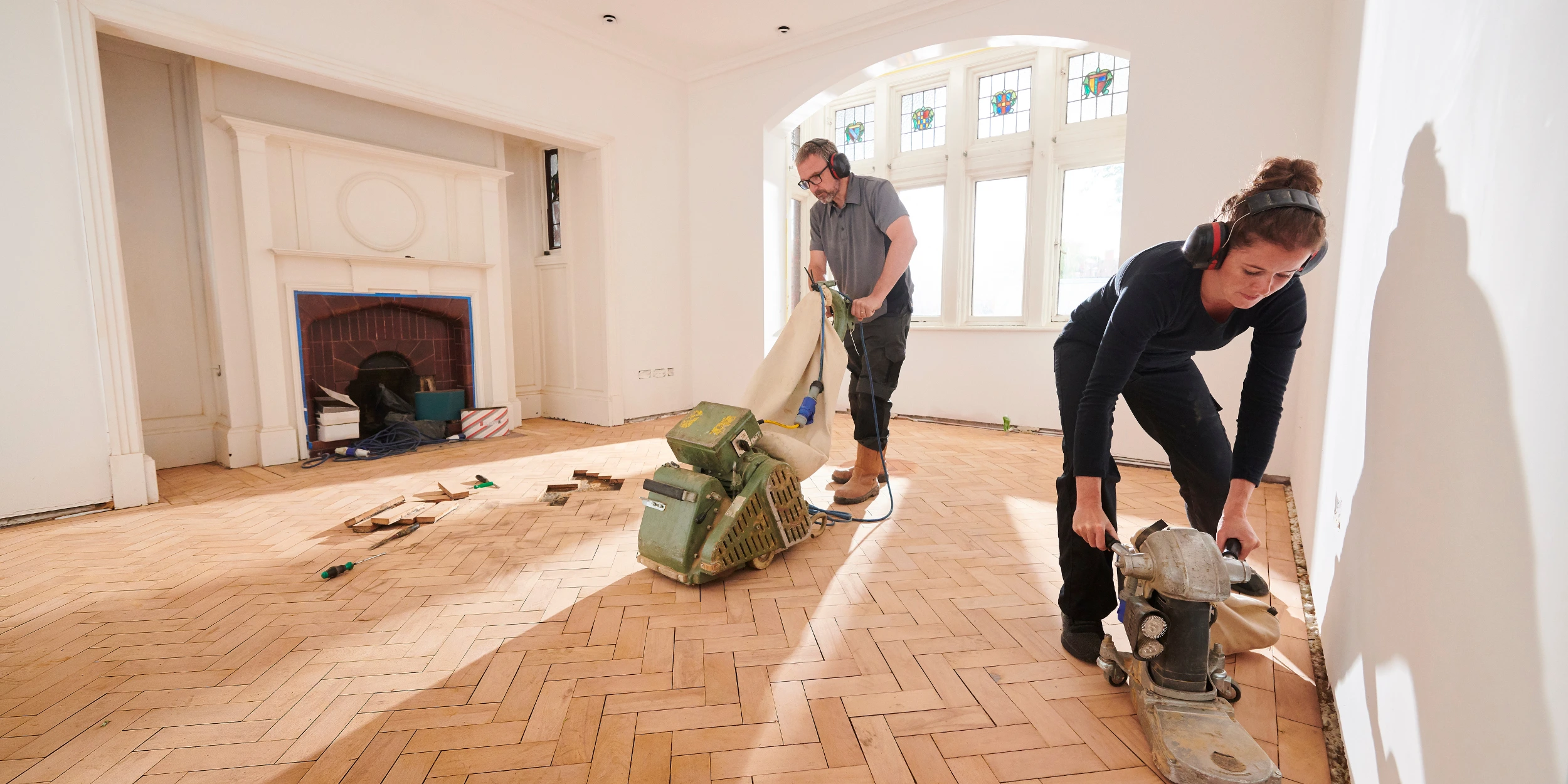
If the creaking is widespread and accompanied by other signs of wear (warped boards, dull or peeling finish, significant gaps between boards), it may be time to consider complete sanding followed by refinishing.
Sanding allows you to level slightly warped boards, eliminate minor surface irregularities, and prepare the wood for a new application of varnish or oil. It is often during this process that professionals also inject glue into problematic joints and re-screw poorly attached boards.
On the South Shore, our sanding service at Artisan Espace Design includes a complete floor inspection before work begins. We identify all problem areas and treat them before proceeding with sanding, so the result is flawless and durable.
Solution 6: Control the Humidity in Your Home
If the creaking appears mainly in winter, it is probably related to dry indoor air. Quebec heating dries the air significantly, and the wood reacts by contracting, creating gaps between boards and friction.
The long-term solution is to maintain a relative humidity level between 40% and 55% in your home. An ultrasonic or evaporative humidifier can make a big difference. On the South Shore, several homeowners install a central humidifier integrated into their heating system, which is the most effective and discreet solution.
A digital hygrometer ($20 to $50 at any hardware store) will allow you to monitor the humidity level and adjust the humidifier accordingly. This preventive solution can eliminate seasonal creaking without any mechanical intervention on the floor.
Solution 7: Partial Replacement of Damaged Boards
When one or a few boards are clearly damaged, permanently warped, or have significant cracks, targeted replacement is sometimes the best option. This is a surgical intervention that allows you to correct localized problems without touching the rest of the floor.
For nailed boards (traditional nailed floor), replacement requires skill: you must carefully cut the problematic boards, remove the pieces without damaging adjacent boards, then install and finish the new boards so they blend visually with the rest.
This is delicate work that often requires professional intervention, especially if you want an invisible result. Our team at Artisan Espace Design can assess your situation and propose the most appropriate and economical solution.
Artisan Espace Design on the South Shore: Repair or Replace Your Floor
When a homeowner from Brossard, Longueuil, or La Prairie calls us about a squeaky floor, our first step is always a diagnosis. Because the best solution depends on the cause, the overall condition of the floor, and your budget.
At AED, we are honest with you: if your floor can be saved with sanding and a few targeted repairs, we tell you. And if replacement is truly the best long-term option, we explain that clearly as well. Our goal is to help you make the best decision for your home and your budget.
Our showroom in Brossard is open to welcome you and show you all available options, whether for refinishing, partial repair, or a complete new floor. Free estimate with no obligation.
FAQ — Squeaky Floor: Solutions for the South Shore
1. Is a squeaky floor structurally dangerous?
In most cases, no. Creaking is rarely a sign of a serious structural problem. However, if the creaking is accompanied by boards that move, significant unevenness, or if you feel excessive flexibility in the floor, it may be a sign of a problem with the joists. In this case, a professional should inspect the structure before any renovation.
2. Why does my floor creak mainly at night or in the morning?
This is often related to temperature variations. At night, the temperature drops and the wood contracts slightly, creating friction. In the morning, with warming, the wood expands. These repeated movements create creaking that is often more audible at night due to ambient quiet. Better indoor humidity management can reduce this phenomenon.
3. Does a squeaky floor indicate that the wood is dry?
Yes and no. Wood that is too dry (moisture content below 6-8%) can contract and create creaking and cracks. But wood that is too humid can also cause creaking through swelling and friction. The ideal is to maintain the wood at a stable moisture content, which is possible by controlling the relative humidity of your home between 40% and 55%.
4. Does graphite powder damage the floor?
No, graphite powder is a neutral dry lubricant that does not react with wood. It leaves no visible residue after application and cleaning. It is a safe solution for all types of hardwood floors, varnished or oiled. Avoid oil-based or silicone lubricants that can leave stains.
5. Can you install SPC vinyl over a squeaky floor to mask the noise?
Installing a floating floor over a squeaky floor generally does not eliminate the creaking, as the noise comes from movements in the subfloor or joists. In some cases, a thick acoustic membrane can reduce noise, but it is better to correct the problem at the source before installing a new covering.
6. How much does a sanding service cost to eliminate creaking on the South Shore?
Floor sanding often includes repairs to joints and problematic boards. In 2026, the cost is generally between $3 and $6 per square foot (all-inclusive: sanding, repairs, application of two coats of finish) on the South Shore. For a standard home with 1,200 square feet of hardwood floor, expect between $3,600 and $7,200 total.
7. My floor only squeaks when it is cold. Why?
This is a classic phenomenon on the South Shore. During cold periods, heating significantly lowers the indoor humidity level (often below 30% in winter). The wood contracts, creating spaces between boards and increased friction when walking. Installing a humidifier and maintaining a humidity level of 40-50% should significantly reduce this winter creaking.
8. When is it better to completely replace the floor rather than repair it?
Replacement becomes relevant when: (1) more than 30-40% of the surface has problems, (2) the wood is too thin to be sanded again (less than 3 mm residual thickness), (3) there is water or mold damage over a large area, or (4) the floor has already been sanded several times and can no longer be sanded. In these cases, investing in a new floor is more economical in the long term.
9. Can creaking get worse over time?
Yes, if ignored. A nail that has come slightly loose will continue to move and may eventually come out completely, causing a board to lift. A slight crack in a board can expand. It is always preferable to intervene early before the problem worsens and becomes more expensive to fix.
10. Can you do a DIY repair on a hardwood floor?
Yes, for simple solutions like graphite, screws from below, or humidity control. For more complex repairs (board replacement, glue injection, sanding), it is generally preferable to call a professional. Poor intervention can further damage the floor or produce an unsightly result that is difficult to correct.
11. Does scraping or sanding screw heads expose you to finishing problems?
If the screw heads are properly countersunk below the surface and filled with a wood plug or wood filler of the right color, finishing should not be a problem. You must ensure that the filler product is completely dry and sanded level before applying varnish or oil. A professional will know how to measure and tint the filler product for a virtually invisible result.
12. Are there specific commercial products to repair floor creaking?
Yes, several manufacturers offer repair kits for squeaky floors. These products generally contain a glue or lubricant specially formulated for hardwood floors. Results vary depending on the cause of the creaking. For light to moderate creaking, these products can be effective. For more serious problems, professional intervention remains the best option.
Your floor is squeaking and you don’t know where to start? Our team at Artisan Espace Design can help you diagnose and fix the problem. Contact us for a free assessment on the South Shore.
Do you have a flooring project on the South Shore? Request a free quote from the Artisan Espace Design team.